
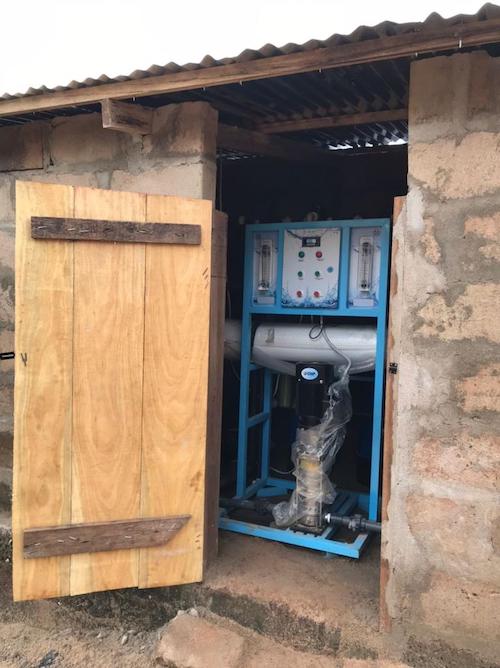
 Our organization recently installed a much needed reverse osmosis, or R.O. , system in the village of Punpunie, Ghana.
Residents will be able to drink safely instead of getting water from their previous hole. Previously citizens had to worry about pollution and water borne illnesses. The biggest pollutants were iron and manganese until now.
According to freshwater systems dot com, such machines get rid of “contaminants from unfiltered water… when pressure forces it through a semipermeable membrane. Water flows from the more concentrated side (more contaminants) of the R.O. membrane to the less concentrated side (fewer contaminants) to provide clean drinking water. The fresh water produced is called the permeate.”
The website also recommended that R.O. filters should changed every six months to a year and every membrane every two to seven years depending if it’s a hard type or soft type. Each also has a storage tank that should be drained every two weeks. This “allows the R.O. system to completely turn the water in the tank.”
We also built a safe water pump. The entire process took about two months with some delays.
At this time our non-profit organization does not have a plan to expand to other communities.
More information about our cause can be found online at https://pocketsofpromise.org.
Sources: “What Is a Reverse Osmosis System and How Does It Work?” n.d. Fresh Water Systems. https://www.freshwatersystems.com/blogs/blog/what-is-reverse-osmosis#1.

 Woodard, John. 2019. “3 Tips to Help Maintain Your Reverse Osmosis System.” Fresh Water Systems. May 14, 2019. https://www.freshwatersystems.com/blogs/blog/3-tips-to-help-maintain-your-reverse-osmosis-system.